AKA: An Honest Update for Vermont Homeowners.
If you’ve been thinking about solar recently, you’ve probably heard a lot of scuttlebutt around changing incentives. And you may even be slightly overwhelmed.
That’s because the solar landscape in Vermont looks remarkably different in 2026, or even just as recently as 27 days ago. Big federal programs have ended, new state-specific opportunities exist, and frankly – it’s caused a lot of confusion. It doesn’t help that many official resources on the subject have yet to be updated for the new year. On December 31st, that 30% federal residential tax credit went away. But for most homeowners, the new setup is actually better.
Here’s more good news: going solar in Vermont is still a fantastic investment that can save you money. You just have to know how the new rules work. And who to trust.
That’s where VT Star Solar excels. As opposed to a big national franchise – we’re Vermonters, through and through. A small team that lives here, works here, and installs here. Focused on two things: giving you the straight facts you need to make the right call and delivering high-value installations that last.
On December 31st, that 30% federal residential tax credit went away. If you’re still looking at last year’s math, you’re looking at a dead playbook. But for most homeowners, the new setup is actually better.
The money hasn’t disappeared; it just moved. New financing models are finding ways to grab those federal credits that homeowners thought they lost.
We’ll walk through where the real incentives are in 2026 and how to stack them so your ROI doesn’t take a hit. Is this finally the year you pull the trigger?
Table of Contents
The Big Picture: What Really Changed in 2026?
Let’s get the energy-inefficient-elephant in the room out of the way first. The 30% federal tax credit for homeowner-purchased solar systems (the one you’d claim on your personal taxes) officially expired at the end of 2025 . This was part of a larger federal bill that ended several clean energy credits.
For homeowners looking to buy a system with cash or a loan, this was a major blow. It made the upfront cost significantly higher.
But it also created a much clearer path forward. And, let’s not forget, VTStarSolar can help you go solar for $0 out of pocket and no upfront cost.
That hasn’t changed.
The #1 Way to Go Solar in 2026: Leases & Power Purchase Agreements (PPAs)
With the residential credit gone, the smartest financial move for most Vermont homeowners in 2026 is a solar lease or PPA. Here’s why:
While the residential credit ended, the commercial tax credit did not. Under Section 48E of the tax code, a 30% tax credit is still available for businesses that install solar—and this includes third-party owners like us and our financing partners .
When you sign a lease or PPA with a company like VT Star Solar, you don’t own the panels. We (or our partner) do. That means we can claim the 30% commercial credit and pass the savings directly on to you in the form of a lower monthly payment.
This is how you can still get the benefits of a 30% tax credit without having to qualify for it or wait for tax season. It’s the new “Golden Path” to going solar with little or no upfront cost.
Get Your Free Solar Analysis Today.
The Vermont-Specific Incentives You Can Actually Get
Beyond the federal workaround, Vermont has some excellent local incentives that make going solar even more attractive. These are the real, verified programs you can count on in 2026.
1. Green Mountain Power (GMP) BYOD Battery Rebate
This is the single best solar incentive in Vermont right now, and it’s a big one. If you’re a Green Mountain Power customer, their “Bring Your Own Device” (BYOD) program will pay you a massive upfront rebate to install a battery backup system with your solar panels.
How much? Up to $10,500.
The program pays you based on the size of your battery, at a rate of $850 to $950 per kilowatt (kW) of enrolled storage. For a typical home battery like a Tesla Powerwall or Enphase IQ Battery, this often works out to a rebate between $9,000 and $10,500.
In exchange, you agree to share a small amount of your stored energy with GMP during a few peak demand events each month (like on the hottest summer days). This helps stabilize the grid for everyone. If there’s ever a storm forecast, GMP automatically stops sharing so you have 100% of your battery power for any potential outages. It’s a win-win.
This rebate is so substantial that it can often cover the entire cost of the battery installation, giving you backup power for free.
2. Vermont Net Metering
Net metering is the system that lets you trade the extra power your panels produce for credits on your electric bill. When your panels produce more electricity than your home is using, that power flows back to the grid, and your utility company credits you for it.
In Vermont, the credit you get for exported power is based on a “blended rate.” As of late 2025, that rate is around $0.14 per kilowatt-hour (kWh) for new systems.
But here’s the most important part: the power you use directly in your home is worth much more. When your panels are producing and you’re running your dishwasher, you’re avoiding buying that power from the utility at their full retail rate (which can be over $0.20/kWh). The more power you use on-site, the more you save.
3. Vermont Property Tax Exemption
This one is simple but powerful. In Vermont, adding a solar panel system will not increase your property taxes. The added value of your solar array is permanently exempt, so you get the benefit of a more valuable home without the extra tax burden.
The Golden Path to $0 Down Solar in 2026
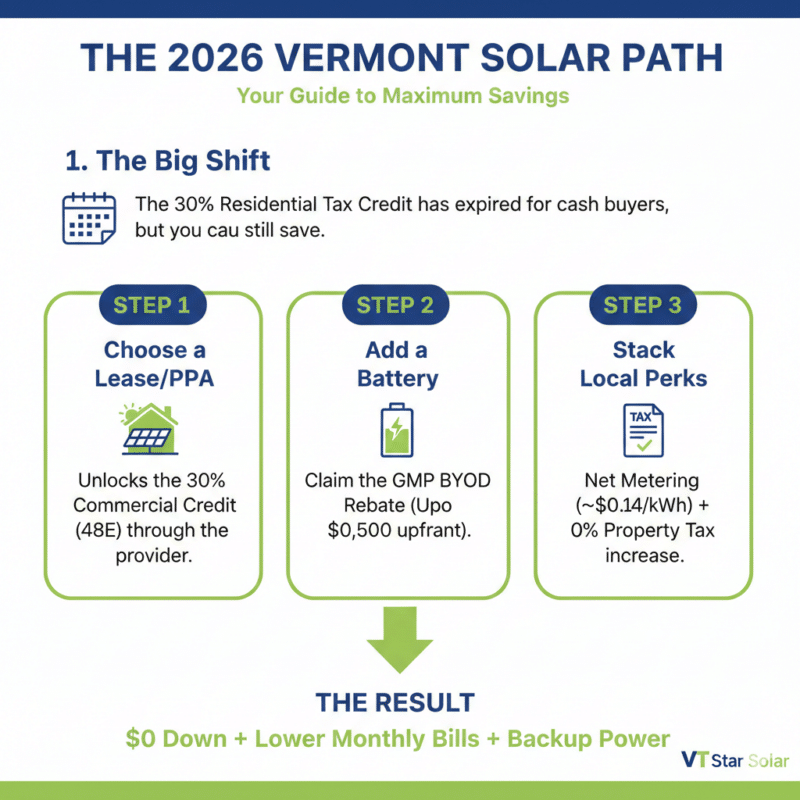
So, how do you put this all together? If you’re a Vermont homeowner in 2026, the path to maximum savings looks like this:
1.Choose a Lease or PPA: This is the key that unlocks the 30% federal credit that is no longer available to individual cash buyers.
2.Add a Battery: Claim the GMP BYOD rebate of up to $10,500. This can often wipe out the entire cost of adding battery backup to your system.
Following this path allows you to get a complete solar and battery system installed on your home for little to no upfront cost, start saving money on your electric bill from day one, and have peace of mind with backup power. It’s the most secure and financially sound way to go solar in Vermont today.
2026 Vermont Solar Quick-Reference Table
| Incentive Type | What You Get | Who Qualifies? | Status for 2026 |
|---|---|---|---|
| Federal Tax Credit (25D) | 30% of total cost | Homeowners (Cash/Loan) | EXPIRED (As of 12/31/25) |
| Federal Lease Credit (48E) | 30% (via lower payments) | Leases & PPAs | ACTIVE through 2032* |
| GMP BYOD Battery Rebate | Up to $10,500 upfront | GMP customers with batteries | ACTIVE & well-funded |
| VT Net Metering | ~$0.14/kWh credit for exported power | All solar owners | ACTIVE (ongoing) |
| VT Sales Tax Exemption | 6% savings on equipment | Everyone | PERMANENT |
| VT Property Tax Exemption | $0 increase in property taxes | Everyone | PERMANENT |
* Section 48E is currently scheduled to phase down starting in 2033, but is at full 30% through 2032.
How to Stack These Incentives for Maximum ROI
Getting the most out of Vermont’s solar incentives isn’t about picking just one program. It’s about layering them on top of each other—stacking them—to create the biggest possible savings. Think of it like building a sandwich; each layer makes the final result better.
Here’s the step-by-step path we walk our neighbors through every day to get them the best possible deal on solar in 2026:
Step 1: The Foundation – The Lease or PPA
This is the most important piece of the puzzle. By choosing a solar lease or Power Purchase Agreement (PPA), you unlock the 30% federal commercial tax credit that is no longer available to individual homeowners. We claim the credit and pass the savings directly to you through a lower, fixed monthly payment. This is the financial engine that makes everything else possible.
Step 2: The Big Rebate – The GMP Battery Incentive
Next, if you’re a Green Mountain Power customer, we help you apply for the BYOD battery rebate. This program provides up to $10,500 in an upfront payment when you add a battery to your system. This incentive is so large that it can often cover the entire cost of the battery, giving you free backup power and energy security.
Step 3: The Daily Savings – Net Metering & Self-Consumption
Once your system is running, the savings start rolling in every day. Here’s how:
- On-Site Savings: The most valuable power you produce is the power you use yourself. Every kWh you use from your roof is a kWh you don’t have to buy from the utility at their high retail rate (often over $0.20/kWh).
- Net Metering Credits: Any extra power you don’t use gets sent to the grid, and you get a credit on your bill for it (at a rate of about $0.14/kWh). Your battery helps you maximize this by storing power instead of selling it cheap, so you can use it yourself later.
Step 4: The Permanent Perks – Tax Exemptions
These are the built-in benefits you get automatically. You save 6% right away because there’s no sales tax on renewable energy equipment in Vermont. And you’ll save for years to come because your property taxes will not increase, even though you’ve added significant value to your home.
Putting It All Together
When you stack these incentives, the picture becomes clear:
You use a lease to get the 30% federal credit savings, add a battery for little to no cost thanks to the huge GMP rebate, and then watch the savings add up every month from net metering and avoiding the utility’s high rates—all while your property taxes stay exactly the same.
Navigating the paperwork for these programs can feel like a chore. That’s our job. We handle the applications and coordination to make sure you get every dollar and credit you’re entitled to, without the headaches.
Frequently Asked 2026 VT Solar Power Questions
Should I lease or buy VT solar panels in 2026?
For most people, leasing or signing a PPA is the clear winner in 2026. Because the 30% residential tax credit has expired, the only way to get a similar financial benefit is to let a third party (like us) claim the commercial credit and pass the savings to you through a lower monthly payment. Buying with cash is still an option, but the payback period is much longer without the federal credit.
Can I still get the 30% federal solar tax credit in 2026?
No. The Residential Clean Energy Credit (Section 25D) expired for systems installed after December 31, 2025 . Any company telling you that you, as an individual homeowner, can still claim it for a new system in 2026 is misinformed.
How much can I save with Vermont solar incentives in 2026?
The biggest direct saving comes from the GMP battery rebate, which can be up to $10,500. When combined with a lease or PPA that bakes in the 30% commercial credit savings, many homeowners can get a full solar-plus-battery system for $0 down and a monthly payment that’s less than their old utility bill.
What is the GMP BYOD battery program and how does it work?
It’s a program where GMP gives you a large upfront rebate to install a battery. In return, you let them draw a small amount of power from it a few times a month to help reduce stress on the electric grid. You get paid for helping out, and you always have plenty of backup power for outages. It’s one of the best battery incentives in the country.
Will solar panels increase my property taxes in Vermont?
It’s a program where GMP gives you a large upfront rebate to install a battery. In return, you let them draw a small amount of power from it a few times a month to help reduce stress on the electric grid. You get paid for helping out, and you always have plenty of backup power for outages. It’s one of the best battery incentives in the country.
Do I need a battery with my solar system in 2026?
It’s not required, but in 2026 it’s a no-brainer, especially if you’re a GMP customer. The BYOD rebate is so generous it can often pay for the entire battery. A battery gives you backup power during outages (which are becoming more common) and helps you use more of your own cheap solar power instead of buying expensive power from the grid at night.
How long does solar installation take in Vermont?
From signing a contract to having the system turned on, the process typically takes 2-4 months. This includes design, permitting with the town and utility, installation, and final inspection. Starting the conversation early is key, especially with the high demand for the GMP battery program.
What happens to my solar power with net metering?
When you produce more power than you’re using, it goes to the grid and you get a credit on your bill (at about $0.14/kWh). When you use power from the grid, you use up those credits. The real magic is using your solar power as it’s being made—that saves you the full retail rate of electricity, which is much higher.
Are these incentives available for businesses and commercial properties?
Yes! The 30% commercial tax credit is the main driver for businesses. While programs like the GMP BYOD are residential, commercial properties have other advantages like accelerated depreciation. If you’re a business owner, we can walk you through a custom ROI analysis.
I heard about a state grant called RAISE. Is that available?
Unfortunately, no. The Residential Assistance in Solar Energy (RAISE) grant was part of a federally funded program that the EPA terminated nationwide in August 2025. It is not available in Vermont.
Ready to See What Your Savings Could Look Like?
Things change, but one thing hasn’t: solar is the best way for Vermonters to take control of their energy costs. The path just looks a little different now. If you’re curious about what these incentives could mean for your home, let’s talk. Our team can put together a free, no-pressure solar analysis to show you the real numbers.