The math for Upstate solar in 2026 actually works out better than the rumors suggest. Because, in spite of what’s changed or disappeared, the state and federal government may still pick up over half the tab depending on your scenario.
Between the NY-Sun rebate that takes a few thousand off the top, and the old 30% federal tax credit (now defunct), most homeowners were seeing their systems pay for themselves in about seven years. It’s not a magic fix, you still have to deal with the new monthly “benefit fee” from utilities like National Grid. But, with electricity rates jumping every year, locking in a set power cost is the only way to stop the bleeding on your monthly bill.

It’s less about “free” power and more about just owning your own miniature utility company. Read on to learn about what’s changed for solar power installations for New York state in 2026.
Table of Contents
The solar landscape really did change towards the end of 2025. The federal residential credit that homeowners used to rely on is gone for new projects, but that does not mean the savings disappeared. In New York State, there are still real programs on the table, including a state income tax credit, NY-Sun incentives in certain cases, property tax protections, and bill credits for excess solar production. The details matter more now.
The 2026 financial case for upstate solar is still strong, provided you look past the generic statewide hype and focus on your specific roof. Success depends entirely on matching active local incentives with your specific utility provider and tax situation.
Since New York isn’t one uniform market, you can’t rely on broad claims; you need a plan built on the math of your own county and installer. Actually, that’s the only way to know if the numbers truly add up for your home.
The Big Picture: What Really Changed in 2026?
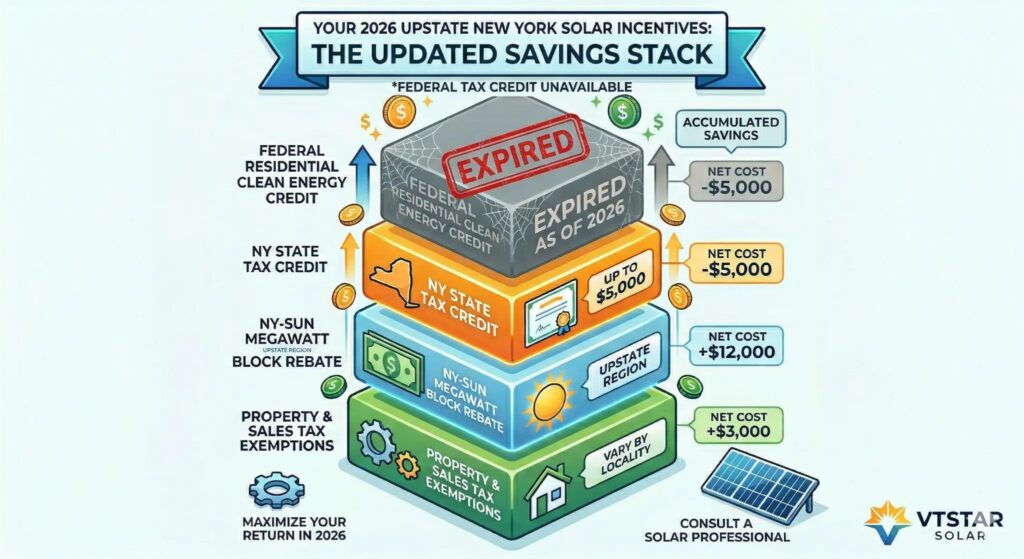
The federal 25D credit officially retired on December 31, 2025. If you are buying a system with cash or a loan right now, that 30% tax break is gone. This makes the upfront numbers a lot tougher than they were last year. But that is not the whole story.
While the direct homeowner credit expired, the commercial version called Section 48E is still active. This is why third party models like leases and PPAs are suddenly the smart play. Since a financing company owns the gear, they can still capture that federal value and build it into your monthly rate.
Actually, it is not quite right to say solar is more expensive now. It is just that the path to the best ROI moved from ownership to leasing. If you are still looking at 2024 calculators, you are basically reading a dead playbook.
The End of the Ownership Era: Why 2026 New York Solar is Different
With the federal residential credit gone, the financing path matters more than it used to. If you buy your system outright, the federal 30 percent homeowner credit is no longer part of the picture for a new 2026 install.
But New York still offers a state personal income tax credit worth 25 percent of qualified expenditures, capped at $5,000, and that credit can also apply in certain lease and long term power purchase agreement structures. That is a big reason New York remains stronger than many other states even after the federal change.
At the same time, third party ownership is still worth serious consideration because of the federal commercial framework under Section 48E. In some cases, that can help lower monthly payments or reduce the effective cost of going solar even though the homeowner is no longer claiming 25D directly. There is no one size fits all answer for Upstate solar in 2026. Your best move depends on a mix of factors, from your tax liability and roof condition to whether you qualify for low-income programs like Affordable Solar. Even the specific utility territory you live in can change your monthly math, especially if you’re adding a battery to the mix.
The key point is this: in 2026, the best solar deal is often the one built around the right ownership model, not just the cheapest sticker price.
The Upstate New York Incentives You Can Actually Get
Beyond the federal shift, Upstate New York still has several real incentives and protections that matter.
1. New York State Solar Tax Credit
New York offers a personal income tax credit equal to 25 percent of qualified solar energy system equipment expenditures, capped at $5,000. If your credit is larger than your tax due, the unused amount can be carried forward for up to five years.
The system must be installed and used at your principal residence in New York State. The same page also states that eligibility can extend to a written lease of solar equipment or a written agreement of at least ten years for the purchase of power generated by solar equipment not owned by you.
That makes this one of the most important homeowner incentives left in New York in 2026.
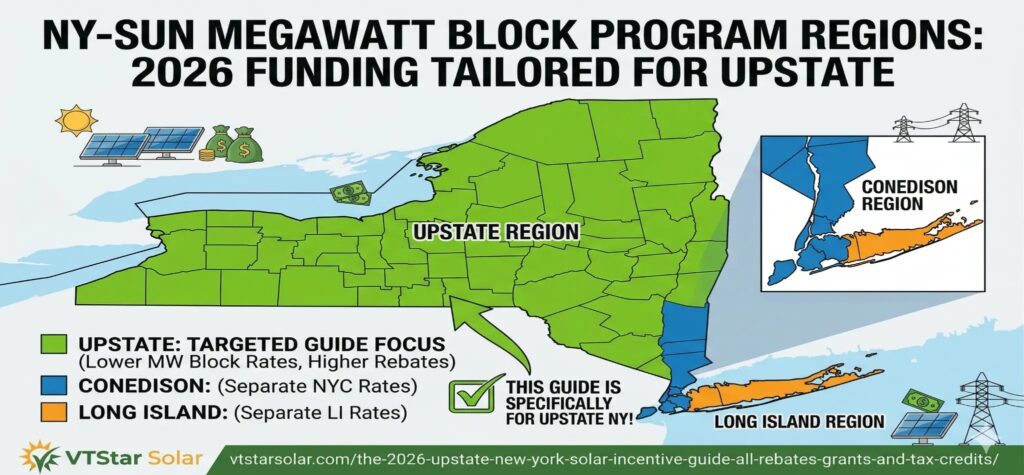
2. NY-Sun Incentives: A Major Change for the Upstate Region
NYSERDA’s NY-Sun program has provided rebates to Upstate homeowners since 2014 – but the program as most people know it has changed in a significant way. The standard residential incentive block for the Upstate region, Block 14, was fully subscribed and closed in December 2025. There is no longer a general per-watt rebate available to every Upstate homeowner in 2026. A lot of resources online haven’t caught up to that yet, which is part of why there’s so much confusion.
What remains is a more targeted program.
Under the NY-Sun initiative, Upstate households that qualify for the Affordable Solar Residential Incentive can still secure a total rebate of $0.80 per watt, applied directly by the installer at the point of sale. For a 7 kW system, that’s $5,600 off the top before the state tax credit even enters the picture. But it’s means-tested – it’s reserved for low- to moderate-income households, and customers need to complete a NYSERDA income eligibility application before a contractor can apply for the incentive on their behalf.
Since the state routes homeowners toward approved contractors to manage that process, the hardest part is usually just confirming your household qualifies. If you do fall into that bracket, this incentive is often the difference between a ten-year payback and a system that pays for itself almost immediately.
If you don’t qualify for the Affordable Solar program, the NY-Sun rebate is no longer part of your calculation. That’s the honest answer for 2026.
3. New York Property Tax Exemption Under RPTL Section 487
New York’s property tax treatment is a big deal. Under Section 487, qualifying solar energy systems are exempt from taxation for 15 years to the extent of any increase in assessed value due to the system. That is one of the strongest long-term protections in the state.
There is an important catch: local jurisdictions can opt out, and some do. So the real takeaway is this: the property tax exemption is potentially very valuable, but it has to be checked locally.
4. Sales Tax Relief on Solar Equipment
New York provides a state sales tax exemption for residential solar energy system equipment, and local treatment can vary depending on whether the city or county elected the local exemption. New York also provides a separate state and local sales tax exemption for residential energy storage system equipment through June 1, 2026. The good news is, the Governor’s 2026-2027 budget proposes extending this through June 1, 2028.
This matters because the solar quote you get can look very different depending on whether battery storage is part of the project and how your locality treats the tax side.
5. Bill Credits for Excess Solar Production
New York homeowners with grid connected solar can still receive bill credits when their system produces more electricity than the home uses. NYSERDA’s homeowner resources explain that excess generation can earn kilowatt-hour credits that roll over to future bills. NYSERDA’s solar materials also note that compensation under the Value Stack is based on the benefits a distributed resource provides to the grid and is delivered in the form of bill credits.
For a homeowner, the practical point is simple: solar still offsets your bill, and extra production still has value. But the exact compensation framework can vary by tariff, timing, and utility territory, so nobody should promise a flat, universal “full retail net metering” result without checking the account details first.
6. Battery Incentives Exist, But They Are More Regional and Program Specific
New York still has residential energy storage incentives through NYSERDA, and the program is structured through regional MWh block dashboards. Incentives are available for up to 25 kWh of storage capacity for qualifying residential systems. There are also additional program layers tied to certain affordability pathways and utility demand response structures.
The reason this matters is that battery incentives in Upstate New York are not as simple as a single statewide rebate number. They are real, but they are more conditional than the old headline-style rebates people often expect.
Why Third-Party Ownership is the New Standard for 2026
So how do we make sense of all this?
If you are a homeowner in Upstate New York in 2026, the strongest path often looks something like this:
- Start by checking if you qualify for the New York State solar tax credit.
- Next, check if your project may qualify for any NY-Sun or affordable solar incentives.
- Verify your local property tax treatment under Section 487.
- Understand how your utility account will handle solar bill credits.
- Compare cash, loan, lease, and PPA options in light of the new post 25D reality.
- If resiliency matters to you, price the battery with current storage incentives instead of assuming it is out of reach.
That is the new playbook. Not one giant federal credit. A stack of state, local, tariff, and financing advantages that have to be lined up correctly.
2026 Upstate New York Solar Reference Table
| Incentive Type | What You Get | Who Qualifies | Status for 2026 |
| Federal Residential Credit (25D) | Previously 30 percent of qualified cost | Homeowners buying systems | Closed – Expired for expenditures after Dec. 31, 2025 |
| Federal Commercial Credit (48E) | Federal project value through qualifying commercial structure | Third party owners and qualifying commercial projects | Active |
| NY-Sun Standard Residential Block | Previously $0.15-$0.20/W | All Upstate residential customers | Closed – Block 14 fully subscribed December 2025 |
| NY-Sun Affordable Solar Incentive | $0.80/W applied at point of sale | Income-qualified households (LMI) | Active – income eligibility required via NYSERDA application |
| RPTL Section 487 | 15 year exemption on added assessed value from qualifying system | Qualifying properties, unless local jurisdiction opted out | Active – but local rules matter |
| Sales Tax Exemption on Residential Solar | State sales tax exemption, local treatment varies | Residential solar equipment | Active |
| Residential Energy Storage Sales Tax Exemption | State and local sales tax exemption | Residential storage systems | Active – through June 1, 2026 |
| Solar Bill Credits | Credits for excess production | Grid connected solar customers | Active – utility and tariff dependent |
Sources behind the table: (IRS)
How to Stack These Incentives for Maximum ROI
Getting the most out of Upstate New York solar is not about finding one magical rebate. It is about stacking the benefits that still exist.
The first layer is the system design itself. A well-sized array that matches your actual usage matters more in 2026 because the easy federal math is gone. Oversizing a project based on old assumptions is a mistake. (Department of Public Service)
The second layer is the state tax credit. New York’s 25 percent credit up to $5,000 is one of the clearest homeowner benefits still left on the table. For many households, this is the anchor incentive now.
The third layer is local and program-specific value. That might mean an NY-Sun affordable incentive, a local property tax exemption under Section 487, favorable sales tax treatment, or a battery incentive that only shows up once your installer runs the exact regional eligibility check.
The fourth layer is bill reduction. Solar still helps you reduce purchased electricity and still generates bill credits when production exceeds consumption. That ongoing utility savings is what turns an incentive package into a long term financial result.
When these pieces line up, Upstate New York solar can still work very well. But you need real local analysis, not a generic statewide promise.
Frequently Asked 2026 Upstate New York Solar Questions
Is a “Prepaid Lease” the secret middle ground for 2026 solar?
It depends more than it used to. Buying can still make sense, especially because New York’s state tax credit remains available, but the loss of the federal residential credit changes the payback. Leases and PPAs deserve a closer look in 2026 because federal value may still be captured through a qualifying third party ownership structure.
Can I still get the 30 percent federal solar tax credit in 2026 as a homeowner?
Not for new homeowner expenditures made after December 31, 2025. That federal residential credit is over for 2026 projects. (IRS)
What tax credit does New York still offer?
New York still offers a state solar tax credit equal to 25 percent of qualified expenditures up to a $5,000 cap, with carry-forward for up to five years if the amount exceeds your tax due.
Are there still solar rebates in Upstate New York?
The honest answer is: it depends on your income. The standard NY-Sun residential block for the Upstate region – the rebate that used to be available to any homeowner – was fully subscribed and closed in December 2025. There’s no general per-watt rebate on the table for the average homeowner right now, and there’s no guarantee new blocks get added. What is still active is the Affordable Solar Residential Incentive, which offers $0.80 per watt for income-qualified households in the Upstate region.
Will solar panels increase my property taxes in New York?
Potentially not, because Section 487 can shield the increase in assessed value for 15 years. But local jurisdictions can opt out, so you need to verify the rule where your property is located. (NY State Tax Department)
Does Upstate New York still have net metering?
Homeowners still receive bill credits for excess generation, and NYSERDA homeowner materials explain that excess production can roll over to future bills. The exact compensation structure may fall under different New York tariff frameworks, including Value Stack concepts, so the real answer depends on your utility and project setup.
Is a solar battery worth it in Upstate New York?
For some homeowners, yes, especially if outage protection matters or if current storage incentives line up with the project. New York still has residential storage incentives, but the amount is not a single statewide rebate figure, so you need a current regional check. Also, residential energy storage systems currently benefit from a state and local sales tax exemption through June 1, 2026.
What if my roof is not a good fit for solar?
Community solar is still a real option in New York. NYSERDA explains that homeowners, renters, businesses, and multifamily buildings can receive bill credits from a shared solar project without installing panels on their own property. There is also a Statewide Solar for All program for eligible low income households that applies monthly bill credits automatically.
Ready to See What Solar Could Actually Look Like for Your Upstate New York Home?
The biggest mistake homeowners make in 2026 is assuming solar no longer works because the old federal credit is gone. The second biggest mistake is trusting a generic online estimate that does not understand New York’s state credit, local tax treatment, utility billing rules, or available NYSERDA programs.
Upstate New York solar can still pencil out. But now it has to be done with real local numbers.