How do New England’s four seasons affect solar? Glad you asked, folks. We’re here for you.
Winter in Upstate New York brings heavy snowfall and shorter days (yay) but did you know a well-designed solar system can still generate up to 75% of its summer output even under snow-prone conditions? Surprising as it sounds, optimized tilt angles, expert snow-removal routines, and the right equipment can dramatically shrink your winter energy gap in Clinton, NY and other upstate locales in the Empire State.
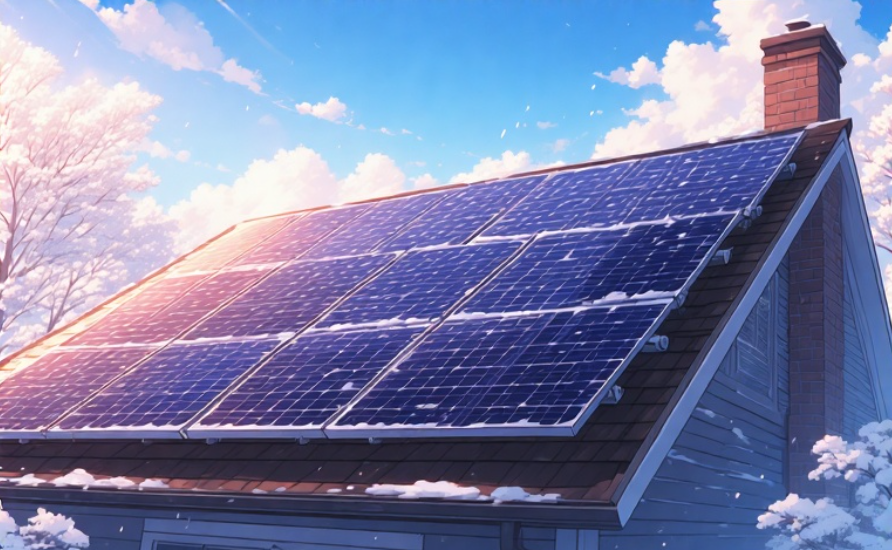
At VTStarSolar.com, we’ve helped homeowners and businesses across Essex County turn winter’s challenges into year-round savings. Read on for actionable tips – plus how to claim federal and state incentives – to keep your panels producing through the coldest months.
Table of Contents
Understanding Winter Solar Challenges in Upstate NY
Upstate New York winters bring low‐angle sunlight, heavy snowfall, and subzero temperatures. Solar output can dip by as much as 40% when panels are flat and coated in ice. Understanding local climate patterns – especially the lake-effect snow in Clinton and the Adirondack foothills of Essex County – helps set realistic performance expectations.
Beyond snow cover, shorter daylight hours reduce peak sun hours. In December, you can expect roughly 3–4 sun hours per day versus 5–6 in summer. System design must account for this seasonal swing to avoid unexpected winter bills.
Optimal Panel Tilt for Snow Shedding
Panels mounted at a steep tilt shed snow more quickly. In Clinton and Essex County, a 35°–45° tilt balances summer capture and winter snow clearance. At 45°, gravity helps most snow slide off after a snowfall, minimizing manual clearing.
Installing adjustable mounting hardware allows seasonal tilt changes. For rooftop systems, VTStarSolar offers tilt‐kit upgrades so you can increase your pitch in November and dial it back in spring – no extra roof penetrations required.
Choosing Snow-Friendly Racking Systems
Standard racks can trap snow, ice, and debris under panels. Instead, specify high‐clearance racks (10–12 inches above the roof deck). This space gives drifting snow a path to fall through rather than accumulating.
Look for rails and clamps rated to withstand heavy snow loads – Essex County building codes often require designs for up to 50 psf ground snow loads. All VTStarSolar racking systems meet or exceed these local requirements.
High-Efficiency Panels for Low-Light Conditions
Cold temperatures increase panel efficiency by 0.3–0.5% per °C drop. Pairing winter-tolerant mono-crystalline panels with anti-reflective coatings boosts low-light capture on gray days. Similar panel models maintain >98% of peak output at 10 °C.
When selecting modules, compare temperature coefficients and low-light power ratings. Even a 0.1% improvement in coefficient can yield hundreds of extra kilowatt-hours over a winter season.
Strategic Panel Placement and Layout
Avoid placing arrays beneath large deciduous trees that can drip meltwater onto panels and cause ice patches. For ground-mounted systems, clear snowbanks at least 5 feet away from panel edges to prevent drifting back under the array.
On rooftops, orient panels to true south (±15°) for balanced winter and summer yields. In east-west orientations, you may gain morning output in December but lose midday sun – consult a VTStarSolar performance model to optimize your layout.
Regular Maintenance and Snow Removal Best Practices
Manual snow removal can improve output by up to 20% after heavy storms.⁵ Use soft-bristle roof brooms or extendable squeegees – never metal scrapers that risk scratching panels. Work from the bottom up in sweeping motions.
Schedule inspections before and after major storms. Look for ice dams on railings, loose clamps, or gutter blockages. VTStarSolar’s winter maintenance plan includes two professional visits and emergency snow‐clearing assistance.
Monitoring and Performance Analytics Tools
Real-time monitoring alerts you when output drops unexpectedly – ideal for spotting snow cover or inverter faults. VTStarSolar’s online dashboard offers daily and hourly kWh comparisons against modeled winter performance.
Set custom thresholds to notify you if a panel string falls below 60% of expected output. Early detection means less lost generation and faster resolution.
Battery Storage Solutions for Winter Reliability
Pairing batteries with solar smooths out production dips. In a typical Essex County winter, a 10 kWh battery can store midday surplus and supply evening loads when panels rest.
Consider hybrid inverters that seamlessly switch between solar, battery, and grid power during storms. VTStarSolar installs Tesla Powerwall® and LG Chem RESU systems, sized to your home’s winter load profile.
Leveraging Federal and State Incentives
New York residents can recoup 26% of equipment and installation costs via the federal Investment Tax Credit (ITC) (U.S. IRS, DSIRE ID 658). There is no cap on the credit, and any unused portion rolls over to the next tax year.
State incentives include the Energy Conservation Improvements Property Tax Exemption, letting Essex County homeowners avoid property tax increases on added solar value (NY Dept. of Taxation and Finance, DSIRE ID 22072). Check local utility rebates – some upstate providers offer $0.10–$0.25 per watt installed.
Partnering with VTStarSolar for Winter-Ready Installations
VTStarSolar’s Upstate Winter Package bundles steep-tilt racks, snow‐shedding panels, and a winter maintenance plan. Our certified installers understand Clinton’s municipal permitting and Essex County’s snow‐load codes, so your project stays on time and on budget.
We handle paperwork for federal and state incentives, ensuring you maximize your savings.
Winter need not be a New York solar setback. With optimized tilt angles, snow-shedding racks, high-efficiency panels, and proactive maintenance, you can sustain 70–75% of peak output through snow season. Leverage battery storage and incentive programs to offset shorter days and project costs.
At VTStarSolar.com, our winter-ready solutions let Clinton and Essex County residents shine year-round. Schedule your free consultation today and start maximizing winter solar performance tomorrow.
FAQ
How often should I clear snow off my panels?
After any snowfall >2 inches. A quick sweep restores output and prevents ice dams.
Can I adjust panel tilt myself?
Only if you have adjustable‐tilt hardware and ladder safety training. VTStarSolar can install a spring-loaded tilt kit for safe seasonal adjustments.
Do solar batteries work in subzero temperatures?
Yes – modern lithium-ion batteries include thermostatic heaters that maintain optimal operating temperature in cold climates.
Are there local rebates in Essex County?
Some utilities offer per‐watt incentives. Contact your provider or check DSIRE for updates. (Source: Solar Rebates and Solar Tax Credits for New York, DSIRE, 08/03/2025)
What maintenance does VT Star Solar provide?
Two pre-winter inspections, emergency snow clearing, real-time monitoring, and 24/7 support.